



Xizang border-trade logistics gain momentum during 14th Five-Year Plan
Updated: 2026-01-04 (chinadaily.com.cn)  Print
Print 


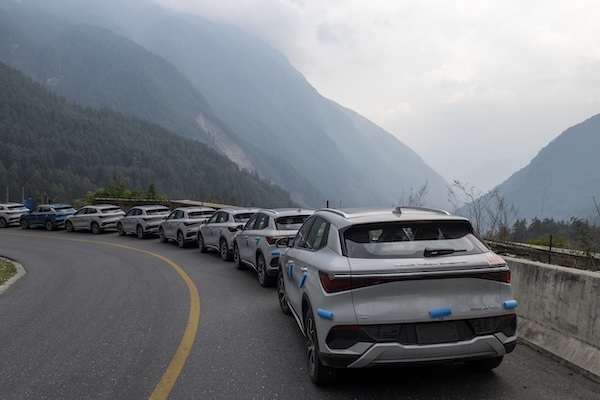
BYD cars wait to cross the border at the Gyirong Port. [Photo/IC]
During the 14th Five‑Year Plan period (2021-25), the border‑trade logistics sector in the Xizang autonomous region saw significant acceleration.
Over five years, the region's foreign trade volume reached roughly 40 billion yuan ($5.72 billion); South Asia freight trains operated 25 times in 2025, with cargo valued at 309 million yuan; and exports of locally made products exceeded 100 million yuan for the first time. These figures reflect Xizang's transformation from a remote opening-up endpoint to an emerging frontier of international connectivity.
Xizang's logistics network expanded rapidly, securing its role as a key node along China's southbound corridor. National-level logistics hubs were established in Lhasa and Shigatse, while the application for an aviation logistics hub in Lhokha advanced steadily.
The Lhasa comprehensive bonded zone, Gyirong border economic cooperation zone, and Lhasa cross-border e-commerce pilot zone were approved, attracting 102 enterprises and forming a cluster that drives sustained trade growth.
Infrastructure upgrades have further strengthened the region's capacity, with Xizang now hosting 146 modern commercial logistics facilities, eight cross-regional cold‑chain centers, and 515,000 cubic meters of cold storage. E-commerce service centers and courier networks also cover all administrative levels.
Customs reforms have cut vehicle clearance times by 85 percent and reduced per‑shipment costs by about 600 yuan, marking a new stage of efficient, convenient, and lower‑cost border‑trade logistics.